[By: Belinda E. Fayo / Student at Cuttington University Graduate School of Global Affairs and Policy]
Introduction
Singapore is a small city-state, located roughly 85 miles north of the equator, with a land area of 274 square miles and total population of 6.11 million people. It is surrounded by much larger neighbors, Malaysia and Indonesia. It is situated strategically on the Strait of Malacca, which connects the Indian Ocean to the Pacific Ocean, specifically the South China Sea. Once a British colony and now a member of the Commonwealth, Singapore first joined the Federation of Malaysia on its formation in 1963 but was separated to become an independent state on August 9, 1965 (Kennard, 2025).
After the early 1980s, the city-state Singapore introduced a defense policy called the “Poisonous Shrimp Policy.” The concept behind this policy is to raise an aggressor’s cost of attacking Singapore to such an undesirable level that no country would consider invading it (Pak Shun, 2005). Singapore approached this by ensuring its military is comparable and in some respects, superior to that of its immediate neighbors.
Lee Kuan Yew, founding Prime Minister of Singapore, quoted once more in a report published by Petir SG (2025), stated, “In a world of big fish; small fish eat shrimps; Singapore must be poisonous shrimp in order to survive.” This speech describes how Singapore would adopt its defensive posture when being attacked. According to General Brigadier, the current Prime Minister of Singapore, “This realization of how Singapore would adopt a defensive posture when being attacked has transformed Singapore’s defense policy from the Poisonous Shrimp philosophy of self-preservation to something more aggressive” (Mustapha, 2014).
Comparison of Singapore and Indonesia Military Strengths in terms of Manpower, Air Power, Land Power, and Naval Power (Global Firepower 2024) Report
Singapore has a robust reserve force of operationally trained professionals who can be quickly mobilized in times of national emergency. In normal times, however, they can continue working in the civil economy and contribute positively to their country (Matthew, 2023).
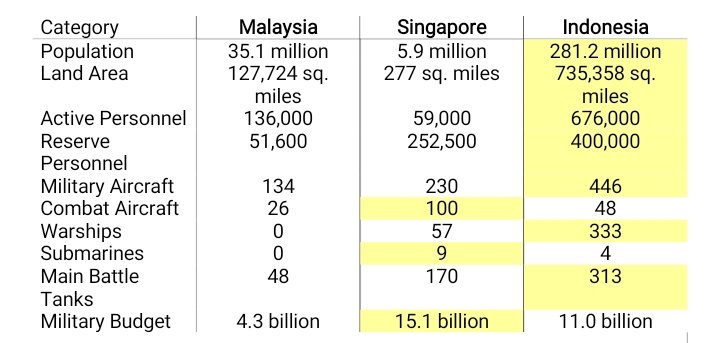
The data above shows that out of ten different factors for national defense, when compared with its neighbors Singapore tops in three and Indonesia tops in seven. If the comparison was only with its former union member, Malaysia, Singapore is higher in seven aspects (Countries Military Forces Comparison: Malaysia vs Singapore, n.d.). Yet, the goal of Singapore is not to become the largest in every aspect as she calls herself a “shrimp” and not a shark.
Meanwhile, Malaysia’s population is 6 times more than Singapore while Indonesia is 45 times larger. In terms of land area, Malaysia is nearly 500 times larger while Indonesia is close to 3000 times larger. Yet these advantages are not translated to equally massive military leads. Additionally, the items on which Singapore leads, speak to quality and not merely quantity: though Indonesia has more military aircraft, Singapore has double its combat aircraft and has four times more than Malaysia’s Combat Aircraft. Similarly, though Indonesia has five times more warships, Singapore has more than double the number of submarines of its two neighbors combined.
Moreover the items on which Singapore’s neighbors have the greatest advantages, such as land mass and sheer numbers, reveal something more interesting: Singapore’s numbers are highly concentrated. With 676,000 soldiers for 735,000 square miles, Indonesia does not even have a one soldier per square mile. On the other hand, Singapore’s 59,000 are defending only 277 square miles, meaning there are 213 soldiers per square mile of Singapore. If Singapore were to fully mobilize its reserve, there would more than a thousand soldiers in each square mile, well equipped using the superior military budget of Singapore.
Singapore’s Economic Edge
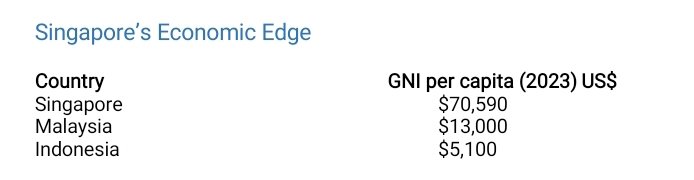
Singapore’s GNI per capita is approximately five to six times higher than Malaysia’s and over thirteen times higher than Indonesia’s. Singapore is classified by the World Bank as a high-income economy, in a different league from its neighbors, which are typically upper-middle and lower-middle-income economies.
Current Status
Over time, Singapore has realized that the defense of its territory needs to be a ‘pre-emptive equation’ rather than a defensive one, much like Israel.” By the early 1980s, the SAF (Singapore Armed Forces), in its second generation, morphed into a “porcupine,” and the third generation saw the SAF upgrade its capabilities into an advanced networked force, becoming a dolphin that is “agile, intelligent, quick and capable of killing more ferocious sharks with its razor-sharp teeth when provoked” (Petir SG, 2025). The significance of this transition is to protect Singapore and to prevent its larger neighbors, Indonesia and Malaysia, from having supreme power over it.
A small country that cannot protect itself puts its sovereignty and its people at risk (Shanmugam K, 2014), Minister of National Security asserts.
Conclusion
Singapore, upon becoming an independent state adopted a policy called the Poisonous Shrimp Policy to protect itself from invasion by its larger neighbors. Despite being a small city-state, it maintains a force of operationally trained military professionals who can be quickly mobilized in times of national emergency. In normal times, however, they are capable of working in the civil economy and making a positive impact on their country. Singapore also has a larger defense budget than its larger neighbor Indonesia and a GNI per capita income that is thirteen times higher than Indonesia’s and approximately five times higher than Malaysia’s. Even though Indonesia has more manpower than Singapore, Singapore leverages technological advancements as a strategy to be more powerful. This article illustrates the national security strategies of Singapore, comparing it to its larger neighbors, Indonesia and Malaysia.
Note: This essay is in partial fulfillment of the Concepts and Theory of International Relations Course at Cuttington University Graduate School of Global Affairs and Policy taught by Dr. Akiah P. Glay with cover provided by Cllr. Phil Tarpeh Dixon.
References
Countries Military Forces comparison : Malaysia vs Singapore. (n.d.). https://www.globalmilitary.net/compare/countries/mys-vs-sgp/
Defence in Regional Security from Critical Analysis Perspective.
Global Firepower. (2024) Comparison of Singapore and Indonesia Military Strength.
Indonesia vs Singapore: Military Facts and Stats. (n.d.). https://www.nationmaster.com/country-info/compare/Indonesia/Singapore/Military
Matthews, R (2020). Singapore’s Total Defence ‘ Styrategy.
Muhammad Asrudin. (2024). The Comparison of Indonesian and Singap
orean
Ng, Pak Shun, (1981). From Poisonous Shrimp to Porcupine. An analysis of Singapore’s Defence Posture Change in the early 1980s.
Petir SG. (2025). The poisonous shrimp theory.
World Bank. (2010). GNI per capita income: Singapore, Malaysia, Indonesia.
About the Author