[By Pewu Y. Sumo]
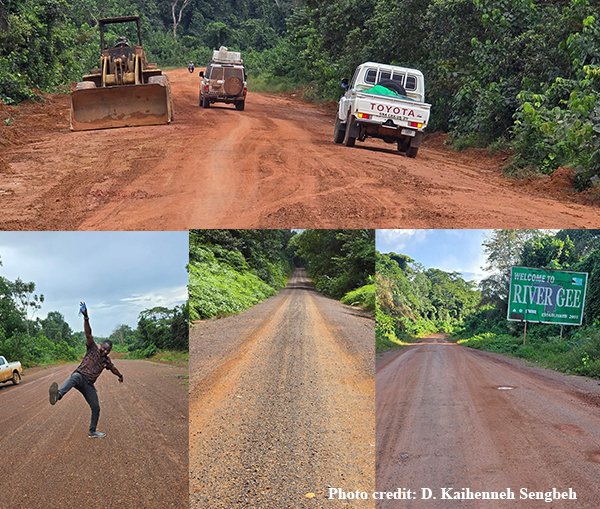
MONROVIA – A remarkable improvement in the road conditions across Liberia’s southeastern counties is being heralded as a powerful sign of national progress, according to a recent account by seasoned Liberian Tax Communicator Danicius Kaihenneh Sengbeh. After a travel period spanning nearly a week, Sengbeh reports that the roads, while not yet paved, are “far better” than in past rainy seasons.
Sengbeh, who traveled the routes from Saturday, October 18, to Thursday, October 23, 2025, emphatically stated, “Truth be told, the roads in the Southeast are plyable.”
The journalist turned tax communicator described the current infrastructure as “solid laterite roads” that are “strong enough to carry the dreams and determination of a people moving forward.” While acknowledging the presence of a few potholes—which he described as “marks of journeys being made”—he stressed that they no longer halt the flow of life.
The tangible result of this improvement is the transformation of travel times. Stories now circulate of journeys that once took weeks now being completed in mere hours.
“This is not just about distance; it is about transformation,” Sengbeh wrote in a commentary on his official Facebook page, noting the connection between Buchanan, Cestos City, Greenville, Harper, Barclayville, Fishtown, and Zwedru. “The Southeast is on the move.”
The personal contrast experienced by Sengbeh served as a potent measure of this success. The Liberia Revenue Authority (LRA) Media and Communication Manager recalled past trips where he was stuck for hours or days, muddied from head to toe, often having to help push vehicles out of the mire.
In contrast, his recent journey involved “no car stuck in the mud; no one abandoned on the highways because of bad roads.”
“This time, whenever I step out of the car, it is not to struggle — it has been to stretch my legs, take pictures, urinate, and ease jetlag. That, in itself, is a silent but powerful testimony of progress,” he observed.
Sengbeh was, however, quick to separate his commentary from political rhetoric, stressing that his observations are “void of politics.” Instead, he attributes the improvement to the collective efforts of Liberian taxpayers.
“This is my testimony. A real story of what our taxes do, of how the few who faithfully pay their taxes are the quiet nation builders of Liberia,” he asserted.
He noted that it is the dollars and cents of citizens that “keep the engines of those yellow machines beating”—fueling the engineers and workers who toil in the jungles and valleys. Along the roads, he saw the heavy equipment “not struggling, but building, maintaining, and improving the very roads that once seemed impossible.”
The veteran Liberian journalist concluded with a call to celebrate this current chapter of development, even in the absence of fully paved highways. He argued that “road maintenance is progress,” and a “passable road is a powerful sign of hope” for a nation rebuilding from war.
“If we can keep more of those yellow machines at work across our country, we can keep the wheels of commerce turning, connect hearts and communities, and remind ourselves that Liberia’s journey is not at a standstill — it is advancing,” he affirmed.
About the Author