[By: Desmond Gbeleh Wion/ Contributing Writer]
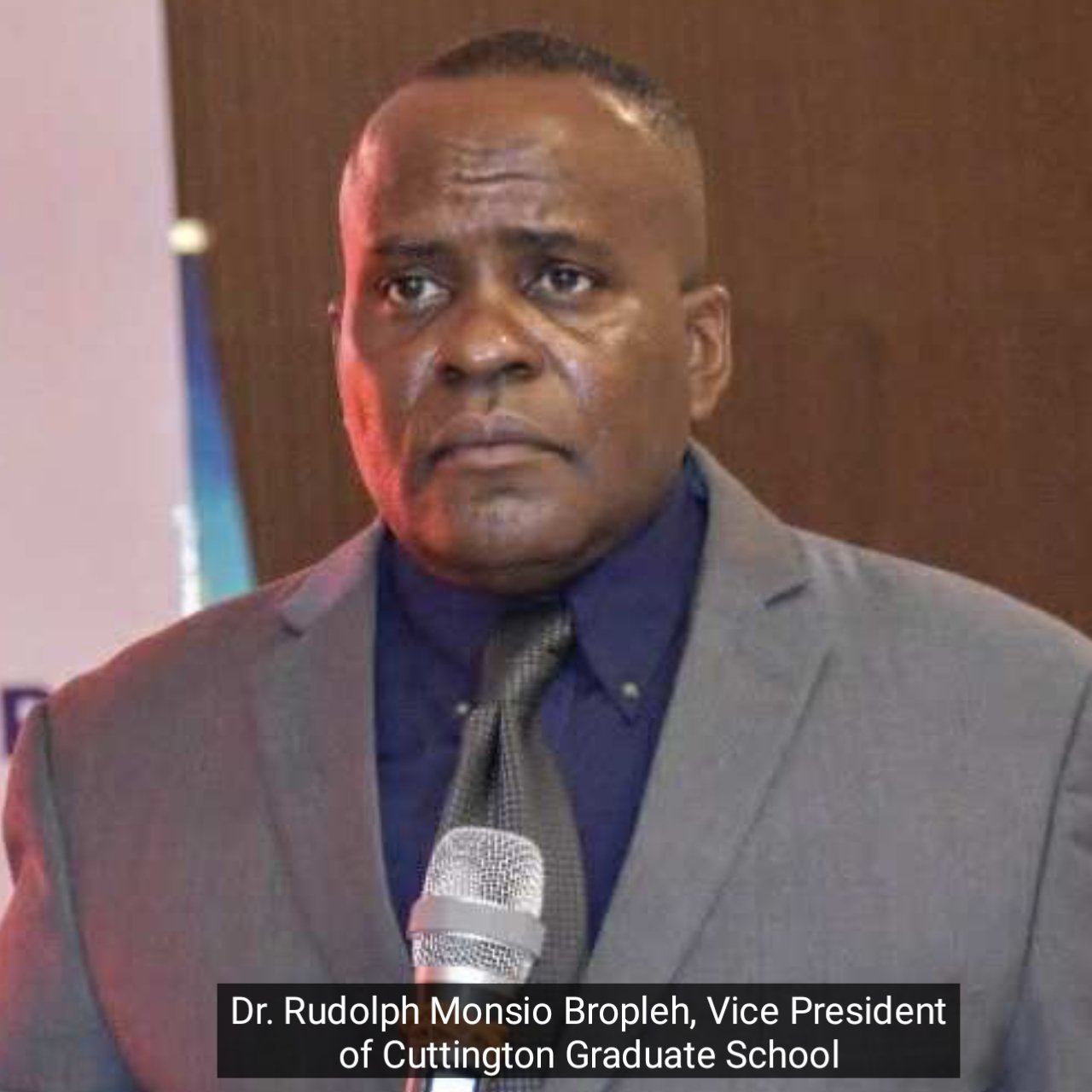
MONROVIA, LIBERIA—— In a sweeping and thought-provoking interview, Dr. Rudolph Monsio Bropleh, Vice President of Cuttington Graduate School, has unveiled an ambitious vision for the future of Liberia’s premier faith-based higher institution — and by extension, offered searing reflections on national leadership, governance, and international relations.
From constructing a state-of-the-art graduate campus to recruiting top-tier PhD scholars, Dr. Bropleh’s message was as bold as it was reformative — setting a new tone for academic excellence, transparency, and developmental synergy between academia and government. Yet, his remarks also ventured beyond the walls of the university, touching national nerves on poverty, governance, and Liberia’s evolving relationship with the United States.
A New Era for Cuttington: Vision, Brains, and Bricks
Dr. Bropleh announced plans to construct a modern, purpose-built graduate school campus, a move he described as “a necessary leap into the future.” He revealed that discussions are already underway with property owners and construction firms to bring the project to life, signaling what could be a transformational chapter in Cuttington University’s storied history.
“We want to provide a learning environment that meets international standards — not just in structure, but in spirit,” Dr. Bropleh said. “The goal is to enhance learning effectiveness and position Cuttington Graduate School as a hub of intellectual and professional excellence in West Africa.”
He added that the administration is aggressively recruiting qualified PhD holders to strengthen the institution’s faculty, particularly for its doctoral programs. The move, he noted, aligns with the school’s commitment to academic credibility and innovation.
Accountability, Student Welfare, and the Spirit of Transparency
On internal governance, Dr. Bropleh emphasized financial resource management, student welfare, and academic discipline as pillars of institutional integrity. He disclosed plans for a “suggestion box” and student appraisal system that would ensure students’ voices are not only heard but acted upon.
“A healthy academic community thrives on transparency, accountability, and feedback,” he asserted. “When students are empowered to evaluate their learning experience, the entire system becomes stronger.”
This model, he argued, will foster a sense of shared ownership and responsibility within the university — bridging the gap between administration and students while promoting mutual trust.
National Reflection: Policies Without Practice Breed Poverty
In a more nationalistic tone, Dr. Bropleh offered a frank critique of Liberia’s socioeconomic condition. He praised President Joseph Nyuma Boakai’s leadership resolve, particularly his recent decision to dismiss several underperforming government officials, describing it as “a step in the right direction.”
“The President’s decision reflects extraordinary leadership — it sends a message that governance must be about results, not rhetoric,” Dr. Bropleh noted. “But he must push even harder; Liberia is still wrestling with deep poverty, and citizens deserve more than policy papers — they need practical solutions that put food on their tables.”
He urged the administration to move beyond the culture of endless policy formulation and adopt a results-driven approach to national development, emphasizing rural empowerment, job creation, and sustainable livelihoods.
On U.S. Visa Policy: A Call for Fair Access, Not Cosmetic Changes
Turning his attention to international affairs, Dr. Bropleh welcomed the U.S. government’s extension of visa validity for Liberians from one to three years, calling it a “positive diplomatic gesture.” However, he cautioned that the policy’s impact remains hollow if the visa approval rate continues to decline.
“It makes little difference to extend visa validity when more Liberians are being denied access,” he argued. “We need fairness and transparency in visa approvals — not symbolic gestures that look good on paper.”
His comments strike a chord at a time when many Liberians have voiced frustration over stringent U.S. visa restrictions despite the long-standing historical ties between the two nations.
Diplomacy and Responsibility: Boakai’s Foreign Trips Under Scrutiny
Dr. Bropleh also weighed in on President Boakai’s recent state visit to France, urging the Foreign Ministry and Liberia’s diplomatic corps to ensure consistent follow-up on the outcomes of such international engagements.
“When the President travels, it must not end with photo opportunities,” he said. “Our ambassadors and foreign ministry must pursue the agreements, trade opportunities, and partnerships that arise from those visits. That’s how diplomacy translates into development.”
His call reflects a broader concern that Liberia’s foreign engagements often lack structured follow-up — a gap that, if bridged, could greatly enhance the country’s global standing and economic cooperation.
On the Garcia Controversy: Diplomacy, Not Dependency
Responding to the recent decision by the Liberian government to accept Salvadoran national Kilmar Armando Abrego Garcia — a man at the center of a U.S. immigration dispute — Dr. Bropleh offered a balanced view.
He described the move as “not entirely negative”, interpreting it within the broader context of strengthening U.S.-Liberia relations under President Boakai and U.S. President Donald Trump, both in their early years of leadership.
“It’s important for both administrations to build strong diplomatic bridges,” he said. “However, this should not become a trend. Liberia must never be seen as a dumping ground for individuals with alleged criminal records. Instead, America should be encouraged to send its investors, not its convicts.”
His statement underscores a growing sentiment among Liberian intellectuals and policymakers who seek a more mutually beneficial partnership with the United States— one based on trade, investment, and technology transfer, rather than dependency.
A Visionary’s Voice in a Time of Transition
Dr. Rudolph Monsio Bropleh’s remarks carry the weight of both an educator and a patriot, a man who sees the future of academia as inseparable from the fate of the nation. His fusion of intellectual leadership with civic consciousness makes his message resonate beyond Cuttington’s campus.
In his view, Liberia stands at a crossroads between promise and paralysis, progress and poverty. Whether in the classroom or the corridors of power, he challenges Liberians to demand results, accountability, and excellence in every sphere of national life.
“We must match words with work, and policies with performance,” he concluded. “That’s how nations rise and that’s how Liberia will.”
About the Author