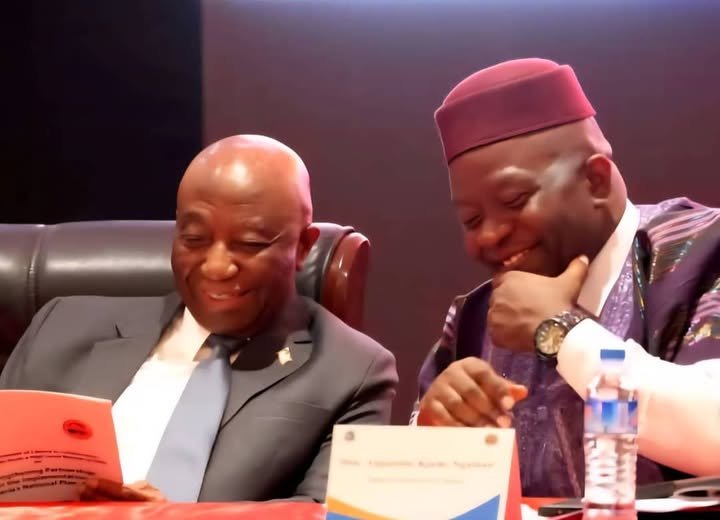
President Joseph N. Boakai (left) in a chat with Finance and Development Planning Minister Augustine K. Ngafuan
[By: Pewu Y. Sumo]
MONROVIA, LIBERIA — The U.S. Government’s Millennium Challenge Corporation (MCC) has reaffirmed Liberia’s eligibility for a second multi-million dollar Compact, marking a major vote of confidence in the country’s commitment to democratic governance and economic reform under President Joseph Nyuma Boakai, Sr.
The reaffirmation decision by the MCC Board of Directors signifies that Liberia has met the agency’s rigorous scorecard criteria, including passing mandatory indicators such as “Control of Corruption” and “Political Rights and Civil Liberties.”
President Boakai welcomed the announcement, which is viewed as a direct endorsement of his administration’s focus on good governance and fiscal discipline.
‘A Long and Bumpy Journey’ Culminates in Success
The process leading to reaffirmation was acknowledged to be challenging, particularly following a temporary pause in Compact development linked to a shift in the U.S. administration’s policy direction earlier this year.
Finance and Development Planning Minister, Augustine Kpehe Ngafuan, credited the achievement to sustained government effort.
“It has been a long and bumpy journey, but we never lost faith. We worked hard, and we have delivered for the President and the people of Liberia,” Minister Ngafuan is quoted as saying in a statement released by MFDP.
Minister Ngafuan, who served as the government’s chief coordinator for the MCC process, spearheaded sustained diplomatic and technical engagement with MCC officials in Monrovia and Washington to ensure the country remained on track. Liberia reportedly passed 12 of 22 indicators on the latest MCC scorecard, surpassing the required minimum of 11.
Next Steps: Energy, Roads, and Reform
Eligibility reaffirmation now paves the way for Liberia and the MCC to enter a detailed Compact development phase. The previous $257 million Compact, which closed in 2021, focused on power (rehabilitating the Mount Coffee Hydropower Plant) and road infrastructure—two binding constraints on the economy.
The second Compact is expected to concentrate on similar high-impact areas critical for private sector growth and job creation: Energy Generation and Distribution, Rural Road Infrastructure, Access to Finance and Business Environment Reforms.
The upcoming phase will involve detailed analytical work and project identification to finalize the Compact’s focus and determine the final funding amount, which could begin implementation as early as 2026.
About the Author