By: Swahilo Donzo
Director for National Development Planning and Coordination/MFDP
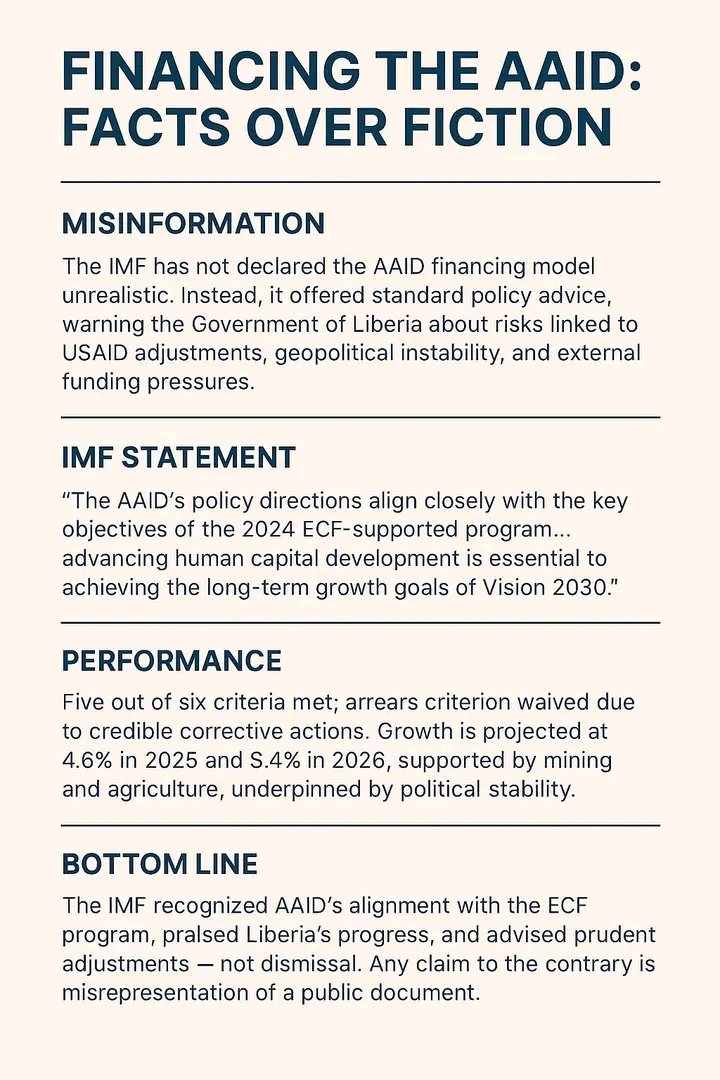
Contrary to misinformation, misrepresentation, distortion of facts, cherry-picking, and self-serving & selective narratives, the International Monetary Fund (IMF) did not declare the AAID financing model unrealistic. Instead, the Fund provided its customary policy advice, reflecting current internal and external risks — including the funding gap from USAID program adjustments, geopolitical instability with repercussions for external support, and other vulnerabilities. The IMF cautioned the Government of Liberia (GoL) about these risks and advised a readjustment of the financing model to safeguard sustainability.
On page six of the IMF’s review, the Fund explicitly states:
“The AAID’s policy directions align closely with the key objectives of the 2024 ECF-supported program. Each pillar is built on targeted measures to address macroeconomic imbalances by improving fiscal sustainability while creating fiscal space for priority investment projects. This approach aims to foster higher, private sector-led growth beyond the traditional enclave sectors of mining and agriculture. Consistent with the program, the AAID emphasizes the need to substantially boost domestic revenue to finance infrastructure development. The AAID also aims at rebuilding foreign reserves and anchoring debt sustainability, which will help rebuild confidence among development partners, particularly amid declining international aid. The emphasis on transparency and governance is critical to create a business-friendly environment that attracts investment. Finally, advancing human capital development—through better education outcomes, greater access to health services, and leveraging demographic dividends—is essential to achieving the long-term growth goals of Vision 2030.”
This is the IMF’s own language. Any attempt to claim otherwise is intellectually obtuse, dishonest and a lazy distortion of a public document.
Regarding Program Performance:
The IMF further commended Liberia’s achievements, noting that five out of six performance criteria were met. The missed criterion — on the non-accumulation of new external arrears — was waived due to credible corrective actions.
The IMF writes:
“Program performance has been broadly satisfactory, with five out of six performance criteria met. A waiver was granted for the missed criterion on non-accumulation of new external arrears, due to credible corrective actions. After a strong post-pandemic recovery, growth moderated in 2024 but is projected to reach 4.6% in 2025 and accelerate to 5.4% in 2026, driven by mining (gold and iron ore) and agricultural recovery. Political stability has supported this outlook.”
Mr. Bo Li, Acting Chair and Deputy Managing Director, praised Liberia’s progress in macroeconomic policy and structural reforms. He highlighted efforts to reduce the fiscal deficit, mitigate debt risks, and strengthen foreign reserves. In response to the sudden loss of large grants — especially from USAID — the government protected critical social programs by cutting low-priority spending and mobilizing domestic revenue. Looking ahead, ambitious revenue mobilization and comprehensive reforms, including an increase in the general sales tax, are planned to support priority development spending.
Bottom line:
The IMF recognized AAID’s alignment with the ECF program, praised Liberia’s satisfactory performance, and offered policy advice to strengthen resilience — not a dismissal of the financing model.
About the Author