[By O’Neill A.R. Philips]
Monrovia — Agriculture Minister, Dr. J. Alexander has called for more funding for agriculture development, as the Government of Liberia and partners launched a €5 million STAR – P and ILSA project to improve soil resilience and enhance smallholder farmers livelihood.
Dr. Nuetah said the Government must consider how it can source additional funding to impart targeted beneficiaries in the agriculture sector of Liberia.
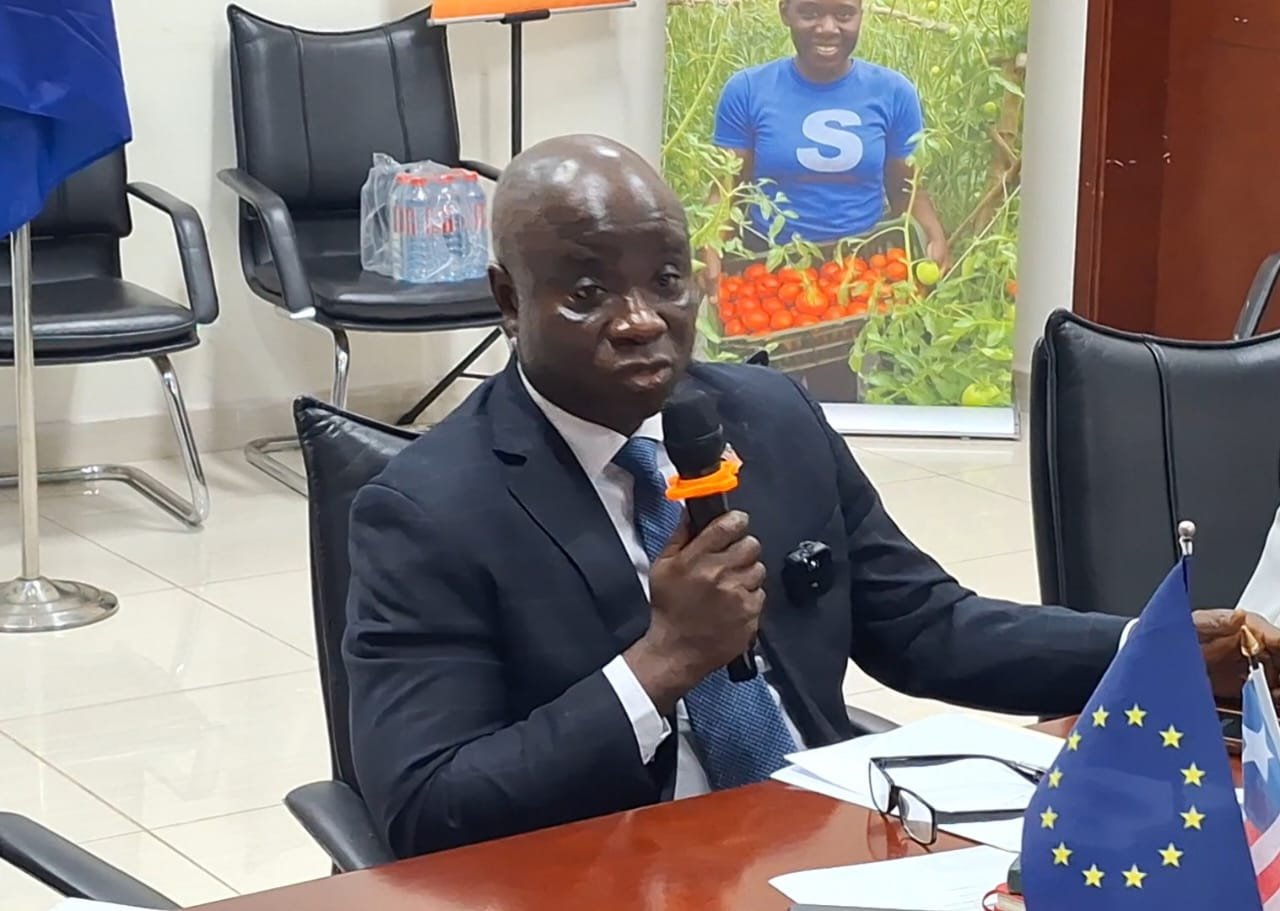
He made the remark at the Ministry of Agriculture ( MOA) on Tuesday, November 11, 2025 at the launch of the Smallholder farmers Transformation and Agribusiness Revitalization Project and Investing in Livelihood Resilience and Soil Health in ACP Countries ( STAR -P/ ILSA )program.
The Agriculture boss said the STAR – P/ ISLA targets about 5300 smallholder farmers, but with €5 million allocated for the implementation of the project and considering the amount intended for each beneficiary, Liberia still has a long way to go.
“As I look at our set target of 5300 beneficiaries, and considering the €5 million for 48 months, I think we should consider how we can get additional funding,” Dr. Nuetah stated.
However, he acknowledged and thanked the European Union (EU) and the International Fund for Agriculture Development ( IFAD) for allocating the largest portion of the fund for African Caribbean and Pacific Countries (ACP) to Liberia.
He emphasized that Liberia needs additional funding for agriculture for the cultivation of rice, cassava, oil palm and vegetables which will serve as fundamental growth for the country’s economic.
Furthermore, in a press release issued by the MOA on November 11, 2025, the MOA said Liberia’s agriculture sector continues to face major financing constraints, despite being the backbone of the economy.
The release quoting a recent World Bank report credits agriculture as the main driver of Liberia’s 4.0% GDP growth in 2024, contributing about 1.3 percentage points, mainly from strong performance in rice and rubber.
Yet, the press release further noted that the proposed 2026 national budget allocates only US$ 13.6 million to the sector, about 1% of the total USD 1.2 billion budget, far below the 10% CAADP benchmark agreed by African leaders.
According to the MOA, of this allocation, the MOA receives USD 9.54 million, the Central Agricultural Research Institute (CARI) USD 2.25 million, the Liberia Agriculture Commodity Regulatory Authority (LACRA) USD 892,118, the Cooperative Development Agency (CDA) USD 848,019, and the Rubber Development Fund just USD 132,152.
The ministry argues that despite employing more than 60% of Liberia’s population, agriculture continues to receive limited fiscal attention. According to the release, this shortfall raises questions about the country’s readiness to achieve food security and rural transformation
Earlier this year, Vice President Jeremiah Kpan Koung reaffirmed Liberia’s commitment to the Comprehensive Africa Agriculture Development Programme (CAADP) Declaration, describing it as a “bold and strategic framework” for achieving agricultural transformation by 2035.
The MOA said Vice President Koung emphasized that Liberia is aligning national strategies with CAADP principles by prioritizing smallholder farming, value chain development, and climate-resilient agricultural practices.In September 2025, Liberia unveiled its ambitious USD 900 million Legacy Investment Program at the Africa Food Systems Forum in Dakar.
The program seeks to transform food systems and stimulate rural growth over the next five years by focusing on rice, cassava, maize, coffee, and oil palm.
Accordingly, Minister Nuetah described the initiative as key to Liberia’s long-term agricultural vision.
“The Legacy Investment Program is intentional about evidence-based provision of inputs, infrastructure, technology, and services that will drive productivity across agricultural value chains, from production to processing, transport, and marketing,” Min. Nuetah stated.
He noted that the program supports the government’s target of achieving lower-middle-income status by 2030, reducing unemployment, particularly among youth and women, and increasing per capita GDP from USD 866 in 2024 to USD 1,115 by 2030.
For her part, IFAD Country Representative Pascaline Barankeba , highlighted the establishment of model farms, youth-led green enterprises, and strengthened national soil laboratories to support long-term sustainability.
Madame Barankeba said the STAR-P/ILSA Project represents a strategic partnership between the government, IFAD, and the EU to build resilient food systems, restore soil health, and promote sustainable agricultural development in Liberia.
“The initiative builds on the successes of IFAD’s STAR-P program and emphasizes sustainable soil management, agroforestry, crop diversification, and locally produced biofertilizers and biopesticides,” Madam Barankeba said. ” “It targets 5,300 smallholder farmers, particularly women and youth, while indirectly benefiting tens of thousands of rural residents,” she added.
The 2025–2029 STAR-P/ILSA Project is funded by the EU through IFAD and implemented by the MOA.
The project aims to restore degraded soils, improve climate resilience, and enhance the livelihoods of smallholder farmers nationwide.
Several personalities including
the EU Ambassador to Liberia, H.E. Nona Deprez, staff of STAR – P/ ISLA as well as representatives from smallholder farmers and cooperatives were in attendance at the program.
The €5 million ILSA program is co-funded by the EU and IFAD and implemented by the MOA.
About the Author