Capitol Hill, Monrovia – What appears to be an endless problem at the state-run University of Liberia (UL), the issue of rampant corruption has continued to affect the welfare of thousands of students since the end of Liberia’s 14-year civil unrest.
In 2013, a reform by then UL Vice President for Academic Affairs and Provost Wede Elliot Brownell to allow “fair pass” for entry into the UL led to fallout with faculty of the university.
Madam Brownell demanded that only candidates who met the required mark from the entrance exam be admitted into the university. Her decision, which did not allow candidates to use “backdoor” entry into the university led to all 25,000 candidates failing in the undergraduate entrance and placement exam in July 2013.
While her decision was aimed at addressing the issue about bribery at the university, it however, did not permit “backdoor” entry money into the pockets of some, which according to an anonymous source, led to her fallout with the faculty.
Following the incident, the faculty of the UL stop teaching; demanding that Madam Brownell resign.
In a letter to the then university’s president, Dr. Emmett Dennis, the faculty association said the school has experienced a drastic decline in academic standards since Brownell’s appointment. They highlighted inconsistencies in her reform policy, labeling it, “unnecessary”, which according to them, led to student failures in the 2013 entrance and placement exams and overcrowded classrooms.
Fast forward in 2025, another issue of allege massive corruption has hit the UL. In a stunning revelation, UL campus-based student movement, the Student Unification Party (SUP) has release a very disturbing evidence of discrepancies at the university.
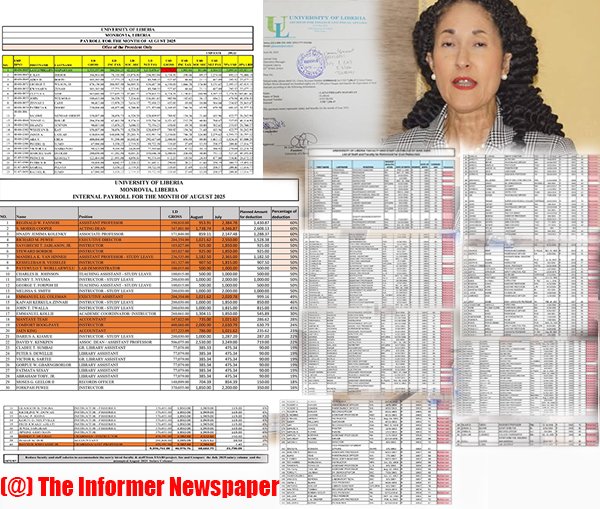
SUP in press conference on August 31, 2025 presented documents of payroll from the university with serious discrepancy in the payroll of newly appointed staff salaries sharply increasing while other long time employees’ salaries drastically decreasing.
The document, a copy of which is in the possession of THE INFORMER NEWSPAPER, found that some employees’ salaries decrease by 60% while some reduce by 50% and some reduce by 40% and below.
Furthermore, SUP said Prof. Dr. Layli Maparyan, as President of the University of Liberia, receives a total monthly salary of USD 15,063.09. This amount is split into two distinct components, which can not address the questions of transparency and financial management within the University of Liberia.
The first portion of USD 7,776.62 is directly funded from the University of Liberia’s official budget while an unofficial allowance Component of USD 7,286.47. This latter portion is paid through a debit memo issued to Ecobank that is drawn directly from the University’s account but is not recorded in the official payroll system. The combination of the official salary (USD 7,776.62) and the unofficial allowance (USD 7,286.47) results in a total monthly compensation of USD 15,063.09. SUP said it is concerned about the “off-the-record” payment mechanism via debit memos which undermines public trust in the University’s financial management. “Maparyan has taken more from the University as opposed to contributing”, SUP said in a statement.
SUP furthered it revelations with a discovery of Dr. Maparyan’s decision to retire about 200 employees of the University, saying, “it trashes Dr. Maparyan’s tyrannical decision to forcibly retire 200 dedicated employees of the University of Liberia, callously targeting them based solely on an arbitrary age limit! These staff including Dr. Mills Jones, Prof. Wilson Tarpeh, Prof. S. Morris Cooper, Ass. Prof. Clifford J. Young, etc – are vibrant, experienced, and brimming with the energy to educate Liberia’s future, but they are being discarded like expendable tools, despite their invaluable contributions to academia”.
SUP argued that age is no measure of worth in a university where wisdom, institutional memory, and mentorship are the lifeblood of progress.
The UL-based student movement label Dr. Maparyan’s “shortsighted purge” as a direct assault on the University’s progress as well as future! “She has failed and must leave now!”, SUP demanded.
“Forcing out 200 capable staff members risks creating a significant gap in the University’s teaching and administrative capacity”. In a resource-constrained environment like Liberia, where qualified educators may be scarce, this move is detrimental to quality education. SUP called on Dr. Maparyan to address the practical needs of students and faculty but instead of retiring employees that show no indication of consultation with faculty, staff, or other stakeholders.
About the Author