Monrovia, Liberia – Chinese Ambassador to Liberia Yin Chengwu has described the Communist Party of China (CPC) as the driving force behind China’s remarkable transformation from a nation plagued by poverty and foreign domination into the world’s second-largest economy and a leading global development partner.
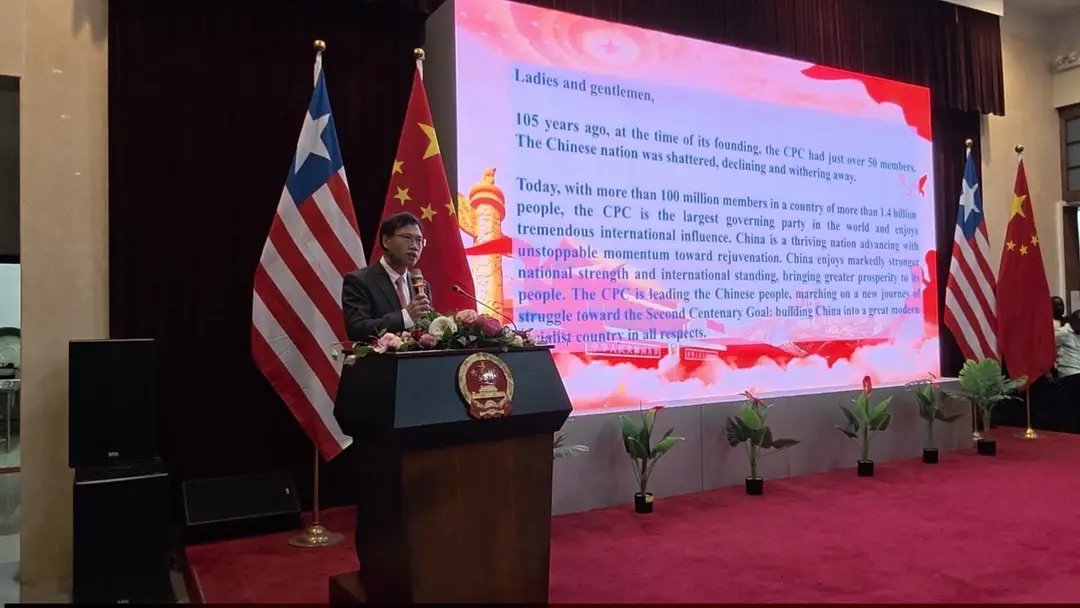
Speaking at a reception marking the 105th anniversary of the founding of the Communist Party of China on June 26 in Monrovia, Ambassador Yin reflected on the Party’s historic journey, achievements, and vision for the future, while reaffirming China’s commitment to strengthening cooperation with Liberia and the international community.
Addressing President Joseph Nyuma Boakai, senior government officials, lawmakers, diplomats, political leaders, and invited guests, Ambassador Yin said the CPC was founded in 1921 at a time when China faced national humiliation and widespread hardship. He noted that the Party was established with the mission of securing happiness for the Chinese people and achieving national rejuvenation.
“The choice of the Communist Party of China was not accidental, but the inevitable outcome of the Chinese people’s long struggle for national liberation and development,” Ambassador Yin said.
He outlined the Party’s achievements over the past 105 years, including leading China’s democratic revolution, establishing the People’s Republic of China, building a socialist state, implementing reforms and opening up the economy, and guiding the country into what he described as a “new era of socialism with Chinese characteristics.”
According to the Ambassador, China has undergone an unprecedented transformation under the CPC’s leadership. He highlighted the country’s rise from a poor and underdeveloped nation to a global economic powerhouse, noting that nearly 800 million rural residents have been lifted out of poverty, marking what he described as one of the greatest poverty reduction achievements in human history.
Ambassador Yin said the Party’s success has been built on three core principles: placing the people at the center of development, maintaining strict Party discipline through continuous self-reform, and pursuing an independent development path based on China’s unique history, culture, and national realities rather than copying foreign models.
He emphasized that the CPC continues to prioritize improving the lives of its citizens through investments in education, healthcare, rural revitalization, employment, elderly care, and social welfare, while strengthening internal governance and combating corruption to ensure effective leadership.
Turning to China’s foreign policy, Ambassador Yin stressed that the CPC remains committed to peaceful development, international cooperation, and mutual respect among nations.
He said China stands ready to deepen exchanges with Liberia and other countries on governance, economic development, modernization, and improving people’s livelihoods. He added that cooperation would continue to be guided by the principles of equality, mutual respect, non-interference in internal affairs, and shared development.
The Ambassador also reaffirmed China’s commitment to advancing major international initiatives, including the Global Development Initiative, Global Security Initiative, Global Civilization Initiative, and efforts to promote a more just and equitable system of global governance.
He called for stronger international cooperation to address common challenges and build what China describes as “a community with a shared future for mankind,” emphasizing peace, security, sustainable development, and shared prosperity.
Concluding his address, Ambassador Yin noted that the CPC has grown from just over 50 founding members in 1921 to more than 100 million members, making it the world’s largest governing political party.
He said China is now moving confidently toward its Second Centenary Goal of building “a great modern socialist country in all respects,” while pledging that the CPC will continue working with countries around the world, including Liberia, to promote development, strengthen partnerships, and improve the well-being of their peoples.
About the Author