By Desmond Gbeleh Wion
MONROVIA, LIBERIA: — Liberia’s modern political history, corruption trials involving powerful public officials have often ended in disappointment, public skepticism, or complete prosecutorial collapse.
Many Liberians have grown accustomed to seeing dramatic indictments announced with confidence, only for the courts to later dismiss the cases for lack of evidence, weak investigation, procedural errors, or politically motivated prosecution.
That is why the outcome of the widely discussed $6.2 million economic sabotage and financial misconduct case involving former Finance Minister Samuel D. Tweah and others represents something fundamentally different under the leadership of Attorney General and Justice Minister Oswald N. Tweh.
This was not a total prosecutorial failure. Neither was it a politically engineered conviction spree designed to punish every accused person at all costs. Instead, what Liberia witnessed was a functioning legal process where evidence determined outcomes — and that distinction may become one of the most important turning points in restoring public confidence in Liberia’s justice system.
For perhaps the first time in years, the Ministry of Justice demonstrated that prosecution is not about media headlines or political revenge, but about presenting facts before the court and allowing the law to take its course.
Out of five defendants indicted by the state, three were convicted. That alone significantly changes the narrative surrounding high-profile corruption prosecutions in Liberia. In legal and institutional terms, that is not defeat — it is a measurable prosecutorial success.
Had all five defendants walked free, critics would have rightly argued that the government failed to establish its case and wasted public resources pursuing empty accusations. But the conviction of three defendants proves that state prosecutors presented credible evidence substantial enough to satisfy the court beyond reasonable doubt against those individuals.
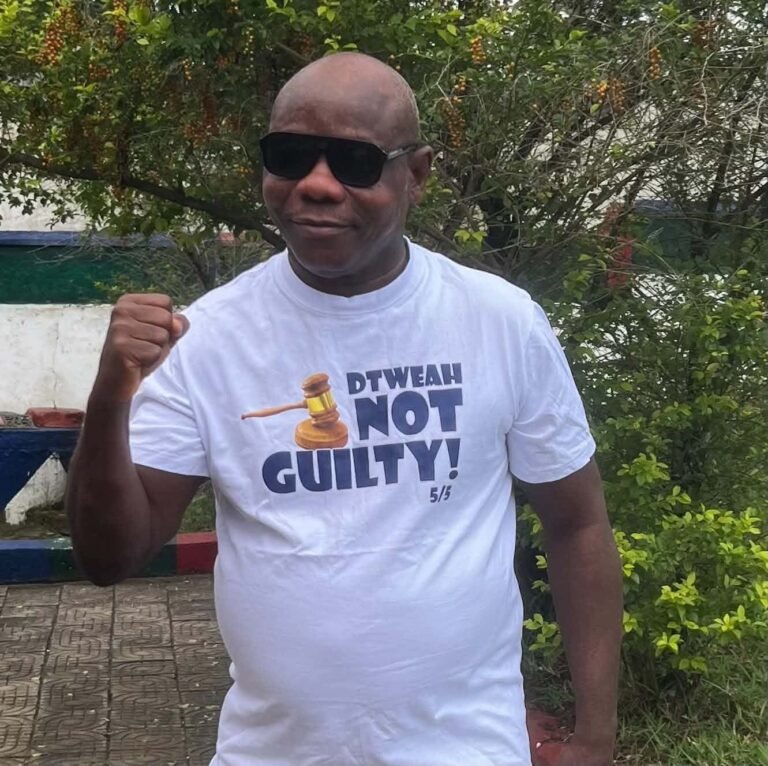
Equally important, the acquittal of two defendants — including former Finance Minister Samuel Tweah — may ironically strengthen the credibility of the prosecution rather than weaken it.
Why?
Because it demonstrates that Liberia’s courts were not acting under blanket political instructions. The judiciary separated individual liability from public emotion. The court evaluated each defendant independently and reached different conclusions based on evidence presented.
That is the true meaning of justice.
A credible justice system is not one where everyone accused is automatically convicted. A credible justice system is one where the innocent can be acquitted while those proven culpable are held accountable.
This balance is exactly what appears to distinguish Attorney General Oswald N. Tweh’s stewardship from several previous administrations that handled major corruption cases with either excessive political aggression or embarrassing prosecutorial weakness.
Over the years, Liberia has witnessed several anti-corruption cases collapse entirely because prosecutors either overpromised, relied heavily on political narratives instead of forensic evidence, or failed to properly prepare cases before going to court. In some instances, the government lost high-profile economic crimes cases against senior officials because investigations lacked technical depth and prosecutorial strategy.
Under Oswald N. Tweh, however, there appears to be a growing emphasis on methodical legal procedure, institutional discipline, and evidence-driven prosecution.
The Ministry of Justice in this case avoided one dangerous temptation that has historically damaged Liberia’s anti-corruption credibility: manufacturing guilt through public pressure.
Instead of forcing convictions against all five accused merely to satisfy political supporters, the legal process produced a mixed outcome — convictions where evidence succeeded and acquittals where the court found insufficient proof.
That balance is precisely why many legal observers believe the Ministry emerged stronger from this case.
The public must understand that prosecutors do not personally determine convictions. Their responsibility is to investigate, present evidence, and argue the state’s position before an impartial court. Once that happens, the final judgment belongs to the judiciary.
Therefore, securing convictions against three defendants in such a politically sensitive and nationally scrutinized case represents a substantial institutional achievement for the Ministry of Justice.
More importantly, this outcome signals a possible cultural shift inside Liberia’s justice architecture.
For years, many citizens viewed anti-corruption efforts as selective, theatrical, or politically motivated. Public confidence weakened because people believed major officials would never truly face accountability. Others feared that prosecutions were sometimes used merely to settle political scores.
But this case introduces a more nuanced reality:
Some accused individuals were convicted.
Some were acquitted.
The court differentiated responsibility.
The state partially succeeded. The judiciary exercised independence.
That combination strengthens the legitimacy of the process.
Attorney General Oswald N. Tweh’s leadership now appears to be gradually repositioning the Ministry of Justice as a more professional legal institution rather than merely a political enforcement arm of government.
His approach projects maturity, restraint, and constitutional discipline — qualities often missing in previous eras of politically charged prosecutions.
The Boakai administration also deserves acknowledgment for allowing the judicial process to proceed publicly and independently without visible executive interference. In many fragile democracies, corruption cases involving former senior officials quickly become politically contaminated. Liberia, at least in this instance, demonstrated signs of institutional separation and judicial autonomy.
Of course, no justice system becomes credible overnight. Public trust is rebuilt gradually through consistency, fairness, competence, and transparency. But cases like this contribute significantly toward restoring citizens’ belief that Liberia’s courts and prosecutors can operate based on law rather than political convenience.
The broader significance of the verdict, therefore, extends beyond the individuals involved.
It sends a message that:
the state can prosecute corruption cases successfully,
the courts can independently assess evidence,
acquittals are possible where proof is insufficient,
and convictions are achievable where wrongdoing is established.
That is how democracies mature.
In the final analysis, the Ministry of Justice under Attorney General Oswald N. Tweh may not have achieved a perfect sweep, but perfection was never the true test. Credibility was.
And by securing convictions against three defendants while respecting a judicial process that acquitted two others, Liberia’s justice system may have gained something far more important than political applause: renewed institutional legitimacy.
About the Author