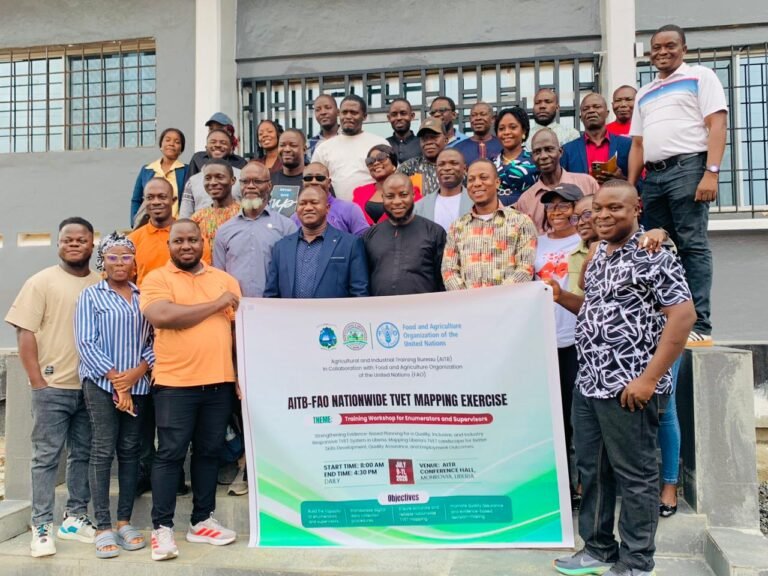
Monrovia, Liberia: — The Agricultural and Industrial Training Bureau (AITB) has raised concern over a significant shortage of qualified instructors within Liberia’s Technical and Vocational Education and Training (TVET) sector, revealing a national gap of approximately 43 percent across trade programs.
Delivering remarks on behalf of the AITB Director General, Hon. Wesley D. M. Nyenatoh, Sr., Deputy Director General for Technical Services, disclosed the findings during a graduation ceremony for TVET instructors trained under the European Institute for Cooperation and Development (IECD) Liberia.
According to him, a recent Gap Analysis and Compliance Monitoring exercise conducted by the Bureau uncovered limited instructor capacity in key technical areas, with many instructors currently teaching outside their fields of formal training.
“These structural challenges directly affect the quality and credibility of TVET education,” Nyenatoh stated. “Where instructional standards are inconsistent, employer confidence declines, and graduates face greater difficulty securing meaningful employment.”
He stressed that the shortage of qualified instructors remains a major factor behind the skepticism of industry actors toward TVET certifications in Liberia.
Despite these challenges, Nyenatoh described the ongoing intervention by IECD Liberia as both timely and strategic, noting that strengthening instructor capacity is essential to restoring trust and aligning skills training with labor market demands.
He commended IECD Liberia for its continued investment in human capital development, emphasizing that competent and industry-relevant instructors are the backbone of a strong TVET system.
Addressing the graduating instructors, Nyenatoh urged them to uphold high standards in both technical proficiency and knowledge transfer, reminding them of their critical role in shaping the country’s future workforce.
“You carry a dual responsibility not only to master your trade but to effectively pass on that knowledge, shaping skills, confidence, and aspirations,” he said.
Reaffirming AITB’s commitment, he outlined key priorities including strengthening instructor standards and certification frameworks, expanding professional development opportunities, and deepening partnerships to enhance quality and relevance in the sector.
The AITB, he noted, remains optimistic that sustained collaboration and targeted investments will significantly improve the credibility and impact of TVET education in Liberia.
About the Author