By Pewu Y. Sumo
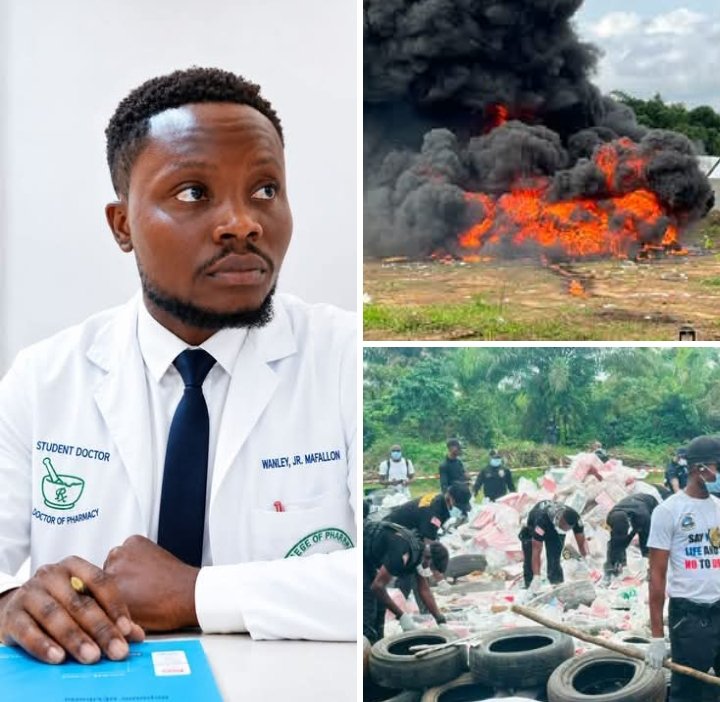
Monrovia, Liberia — Following recent high-profile operations that saw the mass destruction of millions of dollars worth of seized cocaine—underscoring Liberia’s uncompromising stance against transnational drug trafficking—public health advocate Mr. Alfred Mafallon Wanley Jr. has urged authorities to transition from open-air burning to high-temperature incineration to safeguard communities and the environment.
The decisive actions have drawn widespread acclaim for the Joint Security Sector—including the Liberia Drug Enforcement Agency (LDEA), the Liberia National Police (LNP), the Executive Protection Service (EPS), and the Ministry of Justice—for aggressively curbing the availability of dangerous narcotics within local communities.
However, while the intent behind these public destructions is clear, a critical voice within the scientific community is calling attention to an overlooked hazard: the method of disposal.
Writing on the environmental and public health dimensions of the operations, Quality Management and Biosafety student Wanley cautioned that relying on open-air burning for hazardous substances poses significant occupational and ecological risks.
While the eradication of seized narcotics remains legally and socially necessary, open combustion is widely regarded as inconsistent with best practices for hazardous waste management.
Wanley argued that the smoke generated may contain toxic combustion products, fine particulate matter, and chemical residues that can affect law enforcement officers tasked with effectuating the burning exercise, as well as members of the joint security, observers, journalists, emergency responders, and nearby residents. He further noted that beyond immediate exposure, pollutants released into the air may also contaminate the soil and water—posing potential long-term environmental and health risks.
The public health advocate stressed that Liberia is well-equipped with institutional frameworks capable of ensuring safer disposal methods without compromising security objectives.
He highlighted that the Liberia Medicines and Health Products Regulatory Authority (LMHRA) Waste Management Guidelines—modeled after World Health Organization (WHO) recommendations—already outline rigorous procedures for handling hazardous pharmaceutical waste. These guidelines prioritize controlled destruction through approved, high-temperature incineration systems rather than open-air methods.
Additionally, the Environmental Protection Agency (EPA) provides statutory backing for the sound management of hazardous chemicals, working alongside the LDEA’s enforcement mandate.
Wanley emphasized that raising these technical concerns is not a criticism of ongoing security operations, but rather an appeal for continuous institutional growth. As Liberia refines its multi-sectoral approach to dismantling drug networks, public health advocates maintain that technical and environmental standards must evolve in step with law enforcement.
“Medicine and Science should guide policy. Public health should guide practice,” Wanley noted.
According to him, true victory over illicit narcotics requires a comprehensive framework—one where the protection of the citizenry extends to the very methods used to eliminate the threat, ensuring that the process of destruction does not sow the seeds of future public health crises.
“The success of destroying illicit drugs should not be measured only by the amount seized, but also by how safely they are destroyed without creating new, present, or future risks to public health or the environment,” the public health advocate concluded.
About the Author