By Pewu Y. Sumo
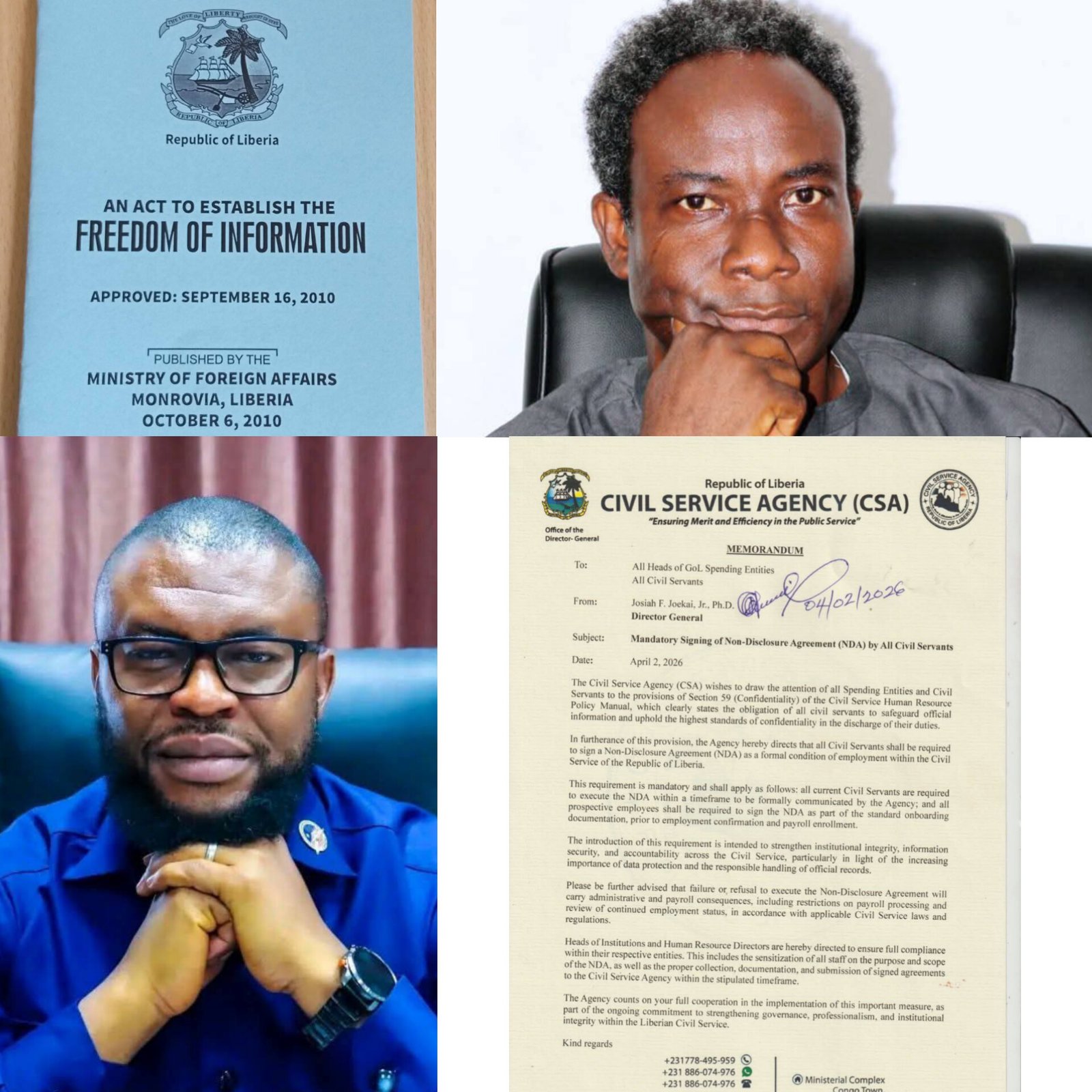
Monrovia — The Independent Information Commission (IIC) has issued a stern advisory regarding the use of Non-Disclosure Agreements (NDAs) in the public sector, asserting that such agreements cannot override Liberia’s Freedom of Information (FOI) Act. This advisory comes just days after the Civil Service Agency (CSA) issued a circular requiring spending entities of the Government of Liberia to effectuate Section 59 (Confidentiality) of the Civil Service Policy Resource Manual.
IIC Commissioner Hon. Joash T. Hodges warned that such a mandate from the CSA requiring civil servants to sign NDAs “must not be used to create a culture of unlawful secrecy or fear,” while acknowledging that protecting sensitive data is legitimate.
“We recognize that NDAs may serve a legitimate purpose in protecting sensitive and confidential information; however, their application must be strictly consistent with the FOI Act, which remains the primary law governing access to information in Liberia,” a statement from the Commission read.
The FOI Act, under Chapter 1, Section 1.7, establishes its legal primacy and renders invalid any administrative measure that is inconsistent with its provisions. Accordingly, no NDA or internal policy should override or limit the statutory right of access to information. Institutions are reminded that the FOI Act applies broadly as provided under Chapter 1, Section 1.6, covering all public authorities as well as private entities performing public functions or receiving public funds; all such entities are bound by the obligations of disclosure established under the Act.
Chapter 2, Section 2.5 of the FOI Act obliges every public authority to publish and maintain certain key classes of information as soon as they are generated or received, whether or not a request has been made. This automatic publication is central to promoting transparency and ensuring public access without delay.
Chapter 2, Section 2.6 further specifies the classes of documents to be automatically published by every public authority, including: enabling legislation, existing policies, procedures, rules, budgets, financial accounts, material contracts, organizational charts (including lines of reporting), and procedures for appealing decisions. This also includes information that enables the public to interact with and monitor the performance of the authority.
This automatic publication framework reinforces that NDAs must not be used to restrict access to information that the law requires to be public. The IIC warned that any NDA attempting to prevent or delay such disclosure is inconsistent with the FOI Act.
Part III, Sections 3.6 and 3.11 of the Code of Conduct for Public Officials and Employees of Government also reinforce this legal position by requiring openness and transparency. It mandates that public officials release information in accordance with the FOI Act while also protecting confidential information as defined by the FOI Act and other regulations. These provisions must be interpreted in harmony with the FOI Act and do not authorize blanket or unrestricted confidentiality.
Institutions must take note that under Chapter 4, Section 4.8 of the FOI Act, information cannot be withheld solely on the basis that it is labeled “confidential” or “secret.” Any refusal to disclose must satisfy the legal requirements of the Act, including demonstrating that the information falls within a recognized exemption, that disclosure would cause harm to a protected interest, and that such harm outweighs the public interest in disclosure.
The Commission also affirmed that Article 16 of the 1986 Constitution of Liberia guarantees the protection of privacy, providing that no person shall be subjected to interference with their privacy except by order of a court of competent jurisdiction. It further emphasized that Chapter 4, Section 4.5 of the FOI Act provides for the protection of personal information and prohibits disclosure that would constitute an unreasonable invasion of privacy. Institutions must therefore ensure that NDAs support, rather than replace, these lawful protections.
Chapter 7, Section 7.5 of the FOI Act provides that any person who discloses information or grants access to information in good-faith reliance on the Act shall be protected from all civil and criminal liability, even if it is later determined that the information was exempt. The same protection applies to persons who receive such information, and NDAs must not impose liability, penalties, or sanctions on officials and employees of the Government for making lawful disclosures.
All NDAs must expressly recognize the primacy of the FOI Act and state clearly that nothing in the agreement shall limit or override lawful disclosure obligations. They must not impose blanket confidentiality obligations but must clearly define what constitutes confidential information in line with the exemptions provided under the FOI Act.
NDAs must explicitly allow for disclosures made pursuant to the FOI Act, disclosures authorized by law, disclosures made under lawful authority, and disclosures made in the public interest. They must not deter or penalize officials and employees of the Government of Liberia for complying with legal disclosure requirements.
Institutions must ensure that staff are adequately informed and trained on the distinction between confidential information and information that is subject to disclosure. NDAs must not be used as instruments to create fear, uncertainty, or unlawful secrecy within the public service.
Furthermore, the use of NDAs must be aligned with proper records management and classification systems. Institutions must develop clear procedures for identifying, classifying, and handling information in accordance with the FOI Act and the Archive Act of 1977.
All existing NDA frameworks are to be reviewed to ensure compliance with this Advisory, and any provision found to be inconsistent with the FOI Act must be revised or removed.
The IIC stated that it will continue to monitor the implementation of NDAs across institutions and will take appropriate action where non-compliance with the FOI Act is identified, reiterating that “transparency is the legal standard, confidentiality is the exception, and all confidentiality measures must be justified within the framework of the FOI Act.”
About the Author