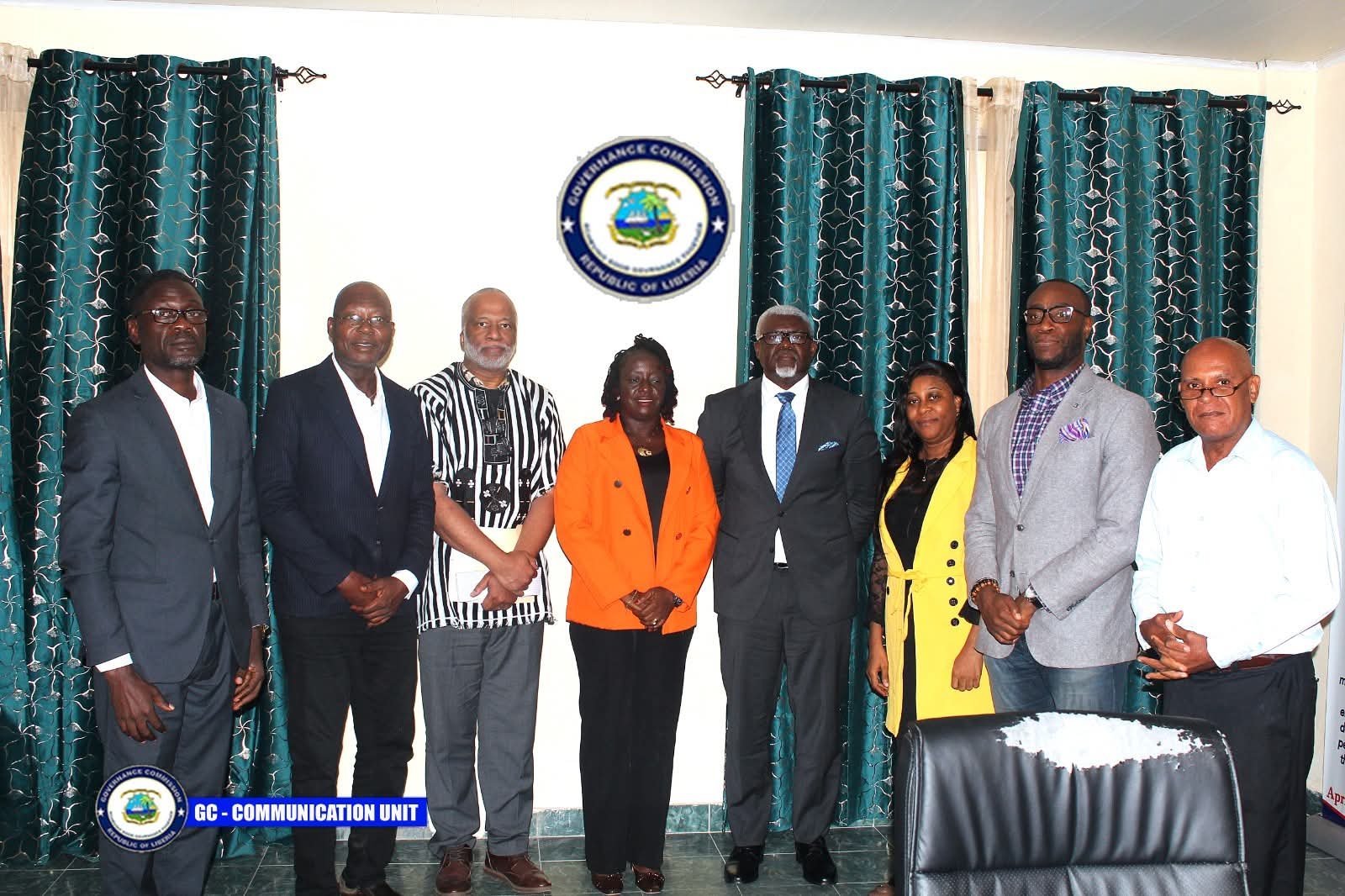
Monrovia — The Governance Commission (GC) on Tuesday welcomed Dr. Herbert Brewer, National Orator of Liberia’s 179th Independence Day Celebration, and Hon. Nathaniel Kwabo, Director General of the Cabinet, to a high level meeting focused on advancing the implementation of President Joseph Nyumah Boakai, Sr’s directive to relaunch the Liberia National History Project (LNHP). The meeting marked a decisive step toward transforming presidential vision into practical action.
Background of the LNHP
The LNHP was first proposed by the Truth and Reconciliation Commission (TRC) in 2009 as part of its recommendations for national healing. The TRC argued that Liberia’s history had long been fragmented, politicized, and incomplete, and called for a comprehensive effort to rewrite the national narrative in ways that included indigenous voices, marginalized communities, and diverse perspectives.
In 2013, the project was formally launched with support from UNESCO and the Liberian Government, with the Governance Commission designated as the institutional anchor. The GC coordinated research, consultations, and policy dialogues, engaging historians, anthropologists, and governance experts. Several Liberian scholars produced abstracts and retrospective analyses covering demography, social cleavages, civics, inequality, governance, political economy, environment, and constitutional reform.
Achievements and Shortcomings
During its early years, the Governance Commission achieved three notable milestones. It organized national and diaspora consultations that brought diverse voices into the process, produced analytical reports that offered a structured framework for rewriting Liberia’s history, and secured policy recognition by elevating history as a tool for peacebuilding and reconciliation.
Despite these achievements, the project was plagued by significant shortcomings. Funding constraints limited sustainability, as UNESCO support was modest and government financing inconsistent. Implementation stalled, with textbooks and curricula never fully produced. Finally, the lack of sustained capacity and independence needed to drive the initiative forward contributed to its stalling.
Symbolic Revival on Independence Day
This trajectory shifted dramatically on July 27, 2026, during Liberia’s 179th Independence Day celebrations in Buchanan, Grand Bassa County, under the theme “Strengthening National Identity Through Liberian-Led Historical Leadership. During his address to the nation, President Boakai revived the LNHP, emphasizing the importance of entrusting the work to qualified Liberian scholars, including historians, archivists, archaeologists, anthropologists, linguists, and educators.
The symbolism of the revival was profound. Independence Day, commemorating Liberia’s founding as Africa’s first republic, provided a fitting backdrop for a renewed commitment to reclaiming the nation’s historical narrative.
President Boakai underscored that Liberia’s identity has been shaped by indigenous civilizations, the return of freed Africans from the Americas and the Caribbean, and enduring ties with the African Diaspora.
He declared that “the strongest nations are united by shared values, common purpose, mutual respect, and a deep sense of identity.”
The President also announced complementary measures to strengthen the initiative. These included collaboration with international partners such as universities, libraries, and cultural institutions abroad to repatriate historical records; modernization of the National Archives and National Museum through digitization, preservation systems, and expanded public access; restoration of the Kendeja Cultural Center as a hub for cultural heritage; and the establishment of an intergovernmental technical committee to oversee modernization and provide institutional oversight.
The Meeting Outcomes
At Tuesday’s meeting, GC Acting Chair Prof. Alaric K. Tokpa welcomed Dr. Brewer and Hon. Kwabo to the Commission, describing their visit on the heels of the president’s directive as a bold demonstration of political will and national commitment to advance an inclusive and accurate history for the country.
Hon. Kwabo pledged the President’s full support to this important national undertaking, assuring the Commission that the Executive will stand firmly behind efforts to ensure the LNHP is successfully implemented. Dr. Brewer, for his part, pledged to remain engaged with the GC and other relevant actors to drive the initiative forward, underscoring the importance of sustained collaboration.
Individual commissioners also took turns to appreciate the national orator and provide diverse perspectives on how best to advance this critical assignment. Their contributions reflected a shared determination to ensure that Liberia’s history is documented in a way that strengthens national identity and reconciliation.
The meeting concluded with agreement on a number of practical measures to ensure the president’s directives are fully implemented. Chief among these is the hosting of a National History Conference, which will serve as a platform for scholars, policymakers, and civil society to chart the way forward for the LNHP.
Looking Ahead
The relaunch of the LNHP represents more than an academic exercise; it is a nation building project. By reclaiming its history, Liberia seeks to foster unity, strengthen identity, and build a confident nation that understands itself. The Governance Commission views this renewed commitment, combined with presidential backing and the engagement of scholars and civil society, as a strong foundation for success.
As Liberia approaches the centenary of landmark events such as the 1926 Firestone Concession Agreement and the Harvard African Expedition, the LNHP offers an opportunity to ensure that future scholarship is increasingly led by Liberian voices. The momentum generated by Independence Day celebrations and reinforced by Tuesday’s meeting signals that Liberia is ready to move beyond stalled efforts and embrace a new chapter in its historical journey.
Credit: Governance Commission
About the Author